Poppy Coburn has become one of the more recognisable names in British opinion journalism in the space of just a few years. As an editor on The Daily Telegraph’s comment desk and a writer whose columns regularly stir debate online, she occupies an unusual position: young enough to speak directly to a generation many newsrooms struggle to reach, yet already trusted with commissioning and shaping the opinion pages of one of Britain’s oldest newspapers. This article walks through her education, her career path, the kind of journalism she is known for, and why she keeps showing up in political conversations on both sides of the Atlantic.
Early Life and Education
Coburn was educated at Colchester Royal Grammar School before going on to study at the University of Cambridge, where she read History and Politics and graduated with a BA (Hons). Her academic focus within the degree leaned toward the history of political thought, with particular attention to the seventeenth-century philosopher Thomas Hobbes — an intellectual grounding that shows up repeatedly in the framing of her later journalism, which often connects present-day political arguments back to older debates about order, authority, and the state.
Student Politics at Cambridge
While at Cambridge, Coburn ran her own campaign to become a representative on the University Council, reportedly becoming one of the youngest women to hold that position. She also took part in the university’s Finance Select Committee, giving her direct exposure to institutional governance and budget decisions at a senior level. For a journalist who would go on to specialise in commentary about institutions, universities, and public life, this early hands-on experience of how a large institution actually runs is often cited as a formative part of her background.
Career Path: From Freelancer to Comment Editor
Coburn’s move into journalism began around 2021, the same period she left Cambridge. She started out contributing freelance opinion pieces and also worked as a primetime producer at GB News, giving her early experience on the production side of broadcast political coverage rather than purely in print.
From there, her byline began appearing more widely. She has written for or contributed to outlets including The Critic, UnHerd, The Daily Express, PoliticsHome, and international syndication partners such as Yahoo and the New Zealand Herald, in addition to her core work at The Telegraph.
Joining The Daily Telegraph
According to The Telegraph’s own author page, Coburn has held an editorial role on the paper’s comment desk since August 2023. Different profiles of her use slightly different job titles — Associate Comment Editor, Assistant Comment Editor, and, during an interim period, Acting Deputy Comment Editor — which likely reflects normal internal role changes over a couple of years rather than any inconsistency in her actual position. In practice, the role involves commissioning, editing, and shaping opinion articles for the paper, alongside writing her own columns.
A notable part of her editorial focus has been coverage of American politics and culture for a British audience. Colleagues and commentators who have discussed her work point to her specific interest in US-facing commentary — writing and editing pieces that explain American political developments, from elections to policy fights, through a lens that is legible to Telegraph readers in the UK.
The Claremont Institute Fellowship
In 2024, Coburn was named a Publius Fellow at the Claremont Institute, a California-based think tank associated with American conservative and constitutionalist thought. Fellowship materials describing her time there reference her Cambridge background, her study of Hobbes, and her prior institutional experience at university. The fellowship is widely seen as having deepened her engagement with American political philosophy and reinforced the transatlantic angle that now runs through much of her editorial work.
What Poppy Coburn Writes About
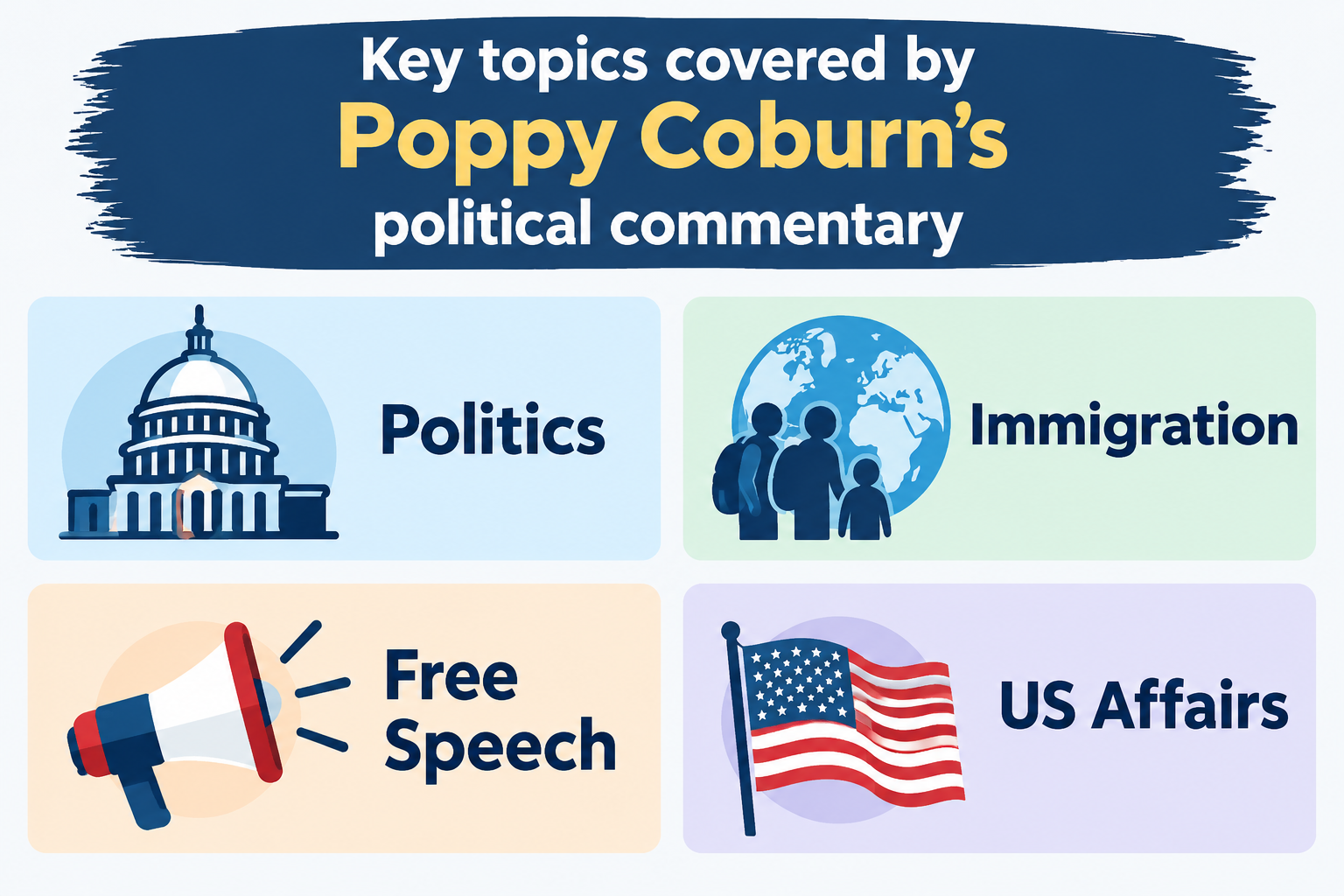
Coburn’s commentary spans a recognisable set of themes:
- British politics and the Conservative Party’s direction after its 2024 election defeat
- Immigration policy and border enforcement
- Welfare policy and public spending debates
- Free speech, universities, and campus culture
- Class and generational change in Britain
- Human-rights law and its intersection with domestic policy
- American politics, viewed from a UK vantage point
Her writing style is generally described as direct rather than hedged: she tends to state a clear position, build an argument methodically around it, and avoid the kind of qualified, both-sides framing that is common in institutional commentary. That approach has helped her build a following that goes beyond The Telegraph’s traditional print readership, particularly through her presence on X (formerly Twitter), where she posts under the handle @kafkaswife — a nod to the writer Franz Kafka rather than any personal or family connection.
Media Appearances
Beyond print, Coburn has appeared in broadcast and podcast formats discussing British and American politics, including segments recorded for The Telegraph’s own video output and appearances discussing generational political trends — for instance, analysis of how younger right-leaning voters differ from both older conservatives and Millennial-era political activism. She has also taken part in public debates, adding a live, unscripted dimension to a career otherwise built mostly around written commentary.
Political Outlook
Coburn is generally categorised as a conservative-leaning commentator, and her published work reflects recurring themes: scepticism toward what she sees as an unexamined political consensus in Westminster, support for a more restrictive approach to immigration, interest in ideas around meritocracy, and close attention to how class and generational shifts are reshaping British politics. She has also been vocal in criticising the framing of “disinformation” as a political concept, arguing that the term is often used more as a rhetorical tool than a precise description.
It’s worth noting that, like most working journalists, her published opinions reflect her professional output rather than a fixed personal manifesto, and her framing on individual issues has evolved as events — such as debates over welfare cuts or party leadership — have unfolded.
Common Questions About Poppy Coburn
Is Poppy Coburn related to BBC presenter Jo Coburn?
No. Coburn has directly addressed this online, clarifying that she has no family relationship to the BBC’s Jo Coburn. The shared surname appears to be coincidental.
What is Poppy Coburn’s age?
Some fan and profile sites list an approximate birth year around 1999–2000, which would put her in her mid-to-late twenties as of 2026. However, this detail has not been formally confirmed by Coburn herself or by The Telegraph, so it should be treated as an estimate rather than a verified fact.
Does Poppy Coburn have a Wikipedia page?
As of now, there is no dedicated, well-established Wikipedia article specifically about her; most in-depth biographical detail circulates instead through her Telegraph author page, LinkedIn, Muck Rack profile, and various independent profile sites.
What is Poppy Coburn’s net worth?
Her exact earnings and net worth have not been publicly disclosed. Given her editorial role at a major national newspaper plus freelance and broadcast work, it’s reasonable to assume a stable, career-appropriate income, but any specific figure circulating online should be treated as speculation rather than confirmed fact.
Why Poppy Coburn Matters in British Media
What makes Coburn’s career worth following isn’t just the speed of her rise — freelance writer to national comment editor in roughly two years — but the specific gap she fills. British newspapers have long struggled to produce commentary on American politics that reads as genuinely engaged rather than imported or superficial. Coburn’s academic background in political thought, combined with her direct fellowship experience inside an American conservative institution, gives her transatlantic commentary a level of grounding that is relatively rare among UK opinion writers of any age.
At the same time, her willingness to take direct, unhedged positions — on immigration, welfare, universities, and party politics — has made her commentary a regular talking point in online political discussion, for supporters and critics alike. Whether that translates into a longer-term national profile, further editorial promotion, or a more prominent broadcast presence remains to be seen, but her trajectory so far marks her as one of the more closely watched younger figures in contemporary British political journalism.
Key Facts at a Glance
| Detail | Information |
|---|---|
| Role | Associate/Assistant Comment Editor, The Daily Telegraph |
| Education | BA (Hons) History and Politics, University of Cambridge |
| Prior roles | Primetime producer, GB News; freelance contributor to The Critic, UnHerd, others |
| Fellowship | Publius Fellow, Claremont Institute (2024) |
| Social media | X: @kafkaswife; Instagram: @poppy_coburn |
| Specialisation | UK politics, immigration, welfare, free speech, US political commentary |