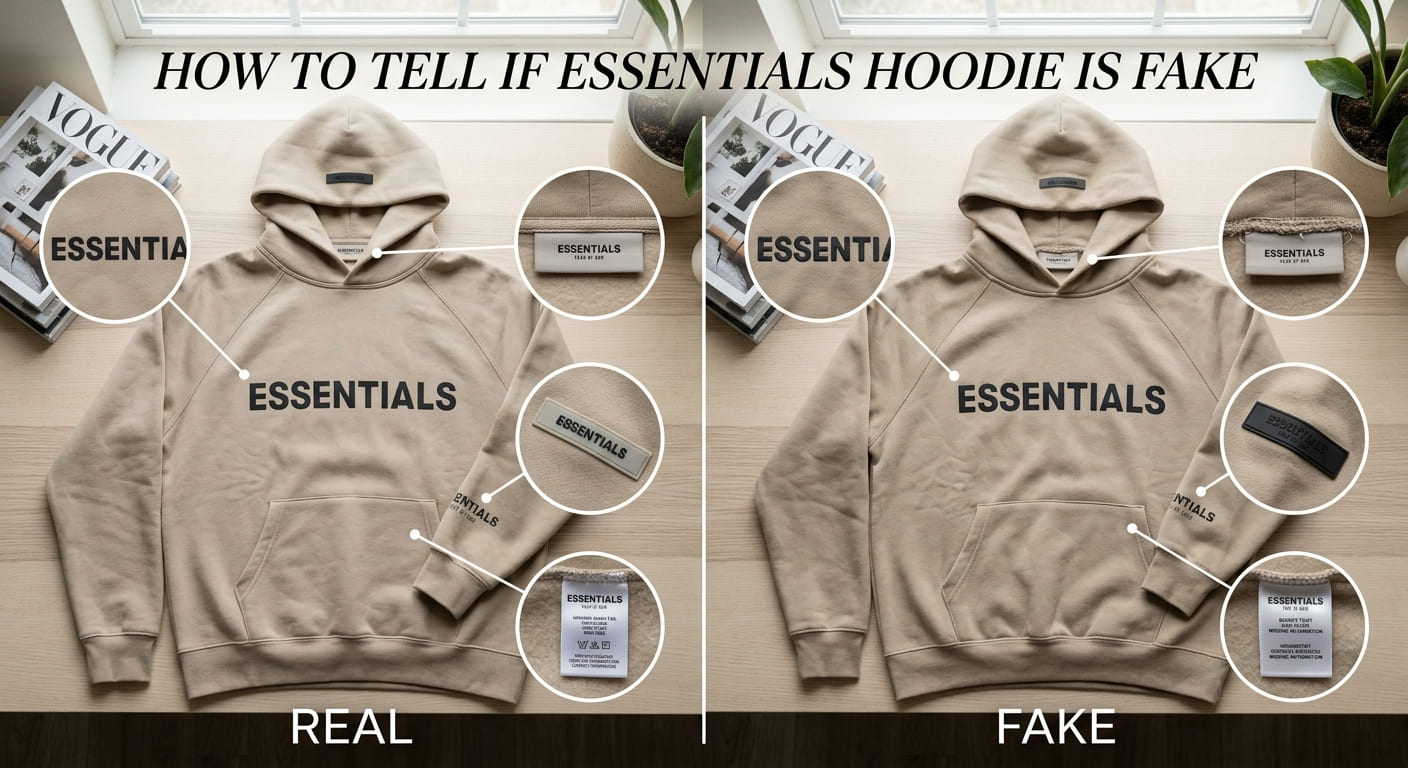
Fear of God Essentials has become one of the most copied streetwear brands on the planet. The minimalist logo, boxy fit, and heavyweight fleece that made it famous are exactly what make it so easy for counterfeiters to imitate — and so easy for casual shoppers to get fooled by. If you’ve ever unboxed a hoodie and thought “something feels off,” you’re not imagining things. There’s a real difference between a genuine Essentials hoodie and a replica, and once you know where to look, spotting it takes less than two minutes.
This guide walks through every checkpoint worth inspecting, from the tag inside the collar to the way the fabric behaves after a wash, so you can buy — or double-check what you already own — with confidence.

Why Counterfeit Essentials Hoodies Are So Common
Essentials sits in an odd sweet spot for counterfeiters. The designs are simple — no complicated graphics, no intricate embroidery, just a wordmark and a boxy silhouette — which makes them far easier to replicate convincingly than a heavily branded piece. At the same time, demand massively outstrips supply. Popular colorways sell out within minutes of release, resale prices climb well above retail, and that gap between what people want and what’s actually available is exactly where knockoff sellers thrive.
Add in the fact that most shoppers are buying through resale apps, social media ads, or third-party marketplace listings rather than the brand’s own storefront, and you have the perfect environment for fakes to circulate. None of this means every deal is a scam — but it does mean you need to know what you’re looking at before you commit to a purchase.
Start With the Price
Before you even touch the hoodie, look at the number attached to it. Essentials hoodies typically retail in a fairly consistent range, and while resale markups exist, there’s a difference between a fair resale price and something priced too low to be believable. If a listing undercuts the going rate by 40% or more with no explanation — no damage, no missing tags, no reason for the discount — treat that as your first red flag, not your last check.
Counterfeiters rely on the assumption that a good price will stop people from looking closer. Don’t let it. Use the price as a reason to inspect everything else more carefully, not as a green light.
Inspect the Tags and Labels
The tags are where cheap counterfeits fall apart fastest, because replicating the exact material, print, and stitching of a label is harder — and less profitable for a counterfeiter — than replicating the visible parts of the garment.
The Feel Test
Pinch the neck tag or wash tag between two fingers and gently bend it. On genuine pieces, this tag typically has a soft, slightly rubbery or woven texture depending on the release. Counterfeit tags tend to feel stiffer, glossier, or more plastic-like, almost like a sticker rather than part of the garment.
Print Consistency
Look closely at the lettering on the wash tag. Authentic text is printed with even weight from letter to letter and line to line — nothing looks noticeably thicker or thinner than the rest. On fakes, it’s common to see uneven ink density, slightly blurred edges, or letters that look like they were printed in a rush.
Size and Care Information
Check that the size marking, care instructions, and any country-of-origin text are spelled correctly and formatted the way you’d expect from a major label. Typos, awkward spacing, or care instructions that don’t match the garment’s actual material are strong tells.
Examine the Fabric and Weight
Essentials built its reputation on heavyweight cotton-blend fleece that feels substantial in your hands. Pick the hoodie up on its own — not on a hanger — and pay attention to how it drapes. Genuine pieces have a noticeable heft; they don’t feel flimsy or float when you move them.
Next, squeeze the cuff or sleeve firmly. Authentic fleece tends to feel dense and springs back into shape quickly. Cheaper counterfeit fabric often feels thin, spongy, or takes a moment to bounce back after being compressed — a sign of lower thread count and looser weave.
If you’re able to wash-test the piece, genuine hoodies generally hold their shape and softness over repeated washes, while replicas often lose structure, pill, or shrink unevenly within just a few cycles.
Check the Stitching and Seams
Flip the hoodie inside out and look at the seams — especially at the armpits, side panels, and hem. Authentic construction uses tight, even stitching with no loose threads, skipped stitches, or fraying. Because these hidden areas aren’t the first thing a counterfeiter focuses on, they’re often where quality shortcuts show up most obviously.
Run your finger along the inside seams. They should feel flat and reinforced rather than raw or bulky. Puckering fabric around the seams, visible glue residue, or threads that pull loose with light tension are all signs of rushed, low-cost manufacturing.
Study the Logo Placement and Print Quality
The “ESSENTIALS” wordmark is deceptively hard to replicate precisely, because its placement and proportions follow a consistent pattern across releases. On genuine hoodies, the logo sits centered and positioned slightly higher on the chest than most people expect. On many counterfeits, it drifts lower, toward the stomach or pocket area, or sits slightly off-center.
Run a fingertip over the print itself. Authentic logos — whether flocked, puff, or flat print — feel integrated into the fabric, with clean, well-defined edges. On fakes, the print often feels like it’s sitting on top of the fabric rather than part of it, with edges that are slightly rough, cracked, or overly thick compared to the rest of the design.
Color matters too. Essentials sticks to a fairly restrained palette of neutrals — black, white, grey, oatmeal, and muted earth tones. If a color looks noticeably more saturated, yellow, or “off” compared to official product photos, that’s worth a second look.
Check the Packaging and Point of Sale
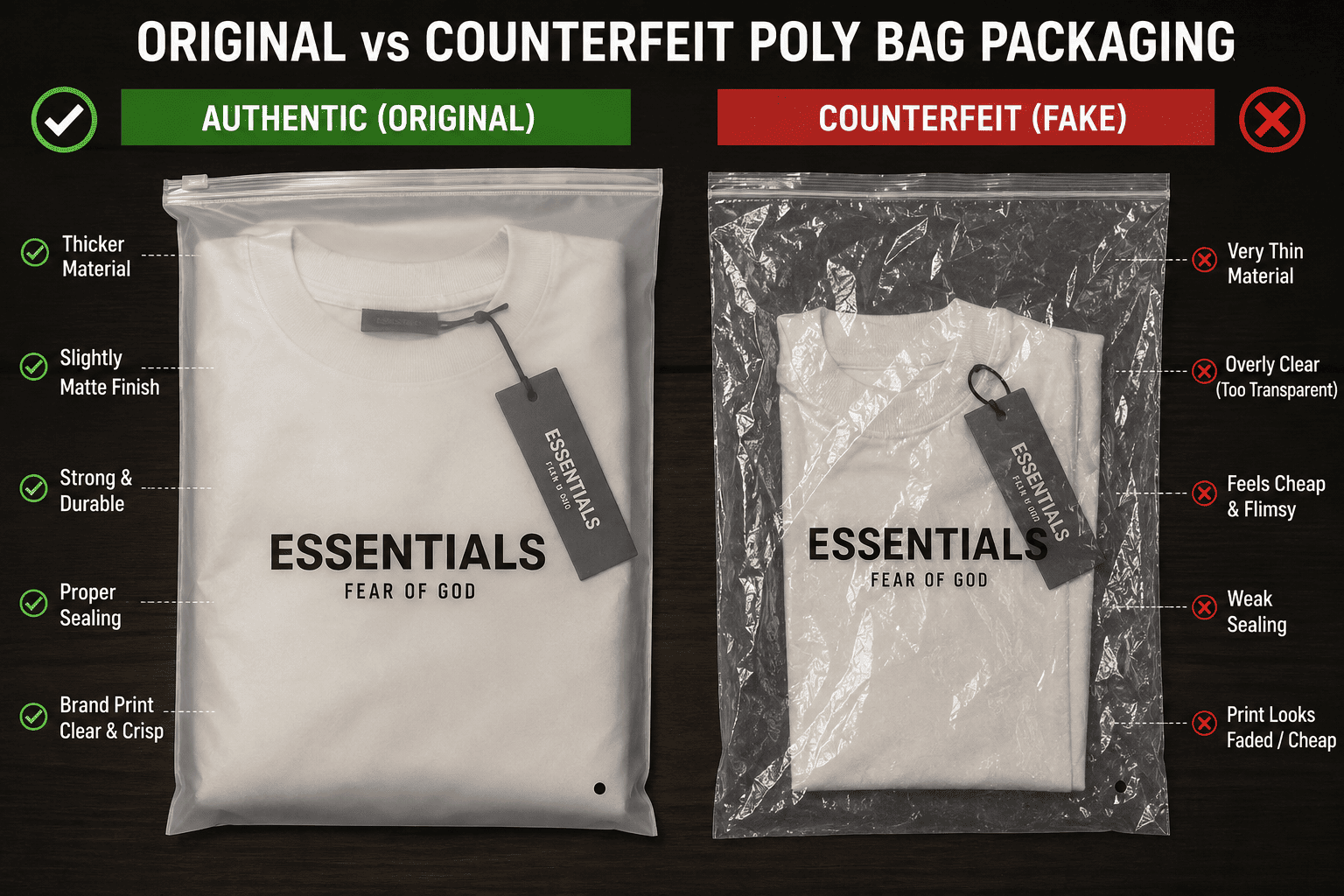
If you’re buying a piece that’s supposed to be new, packaging quality is a strong secondary indicator. Genuine retail packaging tends to be sturdy, with clear branding and consistent print quality on any boxes, hangtags, or poly bags. Poly bags on authentic pieces are often more opaque or lightly frosted, while replica packaging tends to use thinner, overly transparent plastic.
More important than packaging, though, is where you’re buying from. Purchasing directly from the brand’s official site or from established, reputable retailers all but eliminates the risk. Once you move to third-party marketplaces, resale apps, or social media ads, the responsibility shifts to you to verify what you’re getting — read seller reviews, ask for close-up photos of tags and stitching before buying, and be cautious of sellers who refuse to provide them.
Quick Authenticity Checklist
- Price: Reasonable for the item’s condition, not suspiciously low
- Wash tag: Soft, textured feel — not stiff or plasticky
- Print on tag: Even, consistent letter weight, correct spelling
- Fabric: Heavyweight, dense, springs back after squeezing
- Seams: Tight, even stitching with no loose threads
- Logo: Centered, correctly placed, edges feel integrated into the fabric
- Color: Matches the brand’s neutral, muted palette
- Packaging: Sturdy, consistent branding, opaque poly bag
- Seller: Reputable retailer or verified reseller with good reviews
When You’re Still Not Sure
No single detail is a guaranteed verdict on its own — a slightly stiff tag or one loose thread doesn’t automatically mean a hoodie is fake. What matters is the overall pattern. If two or three of these checkpoints look wrong at once, that’s a much stronger signal than any one flaw in isolation.
If you’ve gone through every check and you’re still unsure, a paid legit-check service that specializes in streetwear authentication can offer an expert second opinion, usually for a small fee and a handful of clear photos. For anything approaching full retail price, that’s a worthwhile investment before you commit.
Final Thoughts
Telling a real Essentials hoodie from a fake comes down to trusting your hands as much as your eyes. Counterfeiters have gotten good at nailing the silhouette and the logo from a distance, but the tag texture, fabric weight, stitching precision, and print integration are much harder to fake convincingly. Slow down, check the details in this guide before you buy, and you’ll save yourself the disappointment — and the money — of ending up with a knockoff.